A hissing cockatiel is warning you off, not threatening to attack. It is the sound equivalent of a raised hand, a clear “stop” rather than the lead-up to an assault, and it almost always means your bird feels cornered, startled, or unsure of what is about to happen next.
It can still catch you off guard the first time you hear it, that sharp exhale that sounds more snake than bird coming out of a cockatiel’s small body. Once you know what triggers it and how to respond, though, it stops being alarming and starts being useful information your bird is handing you for free.
What the hiss actually is
Cockatiels do not have a vocal hiss the way a cat does, they make the sound by forcefully exhaling through a slightly open beak, and it serves exactly one purpose: creating distance.
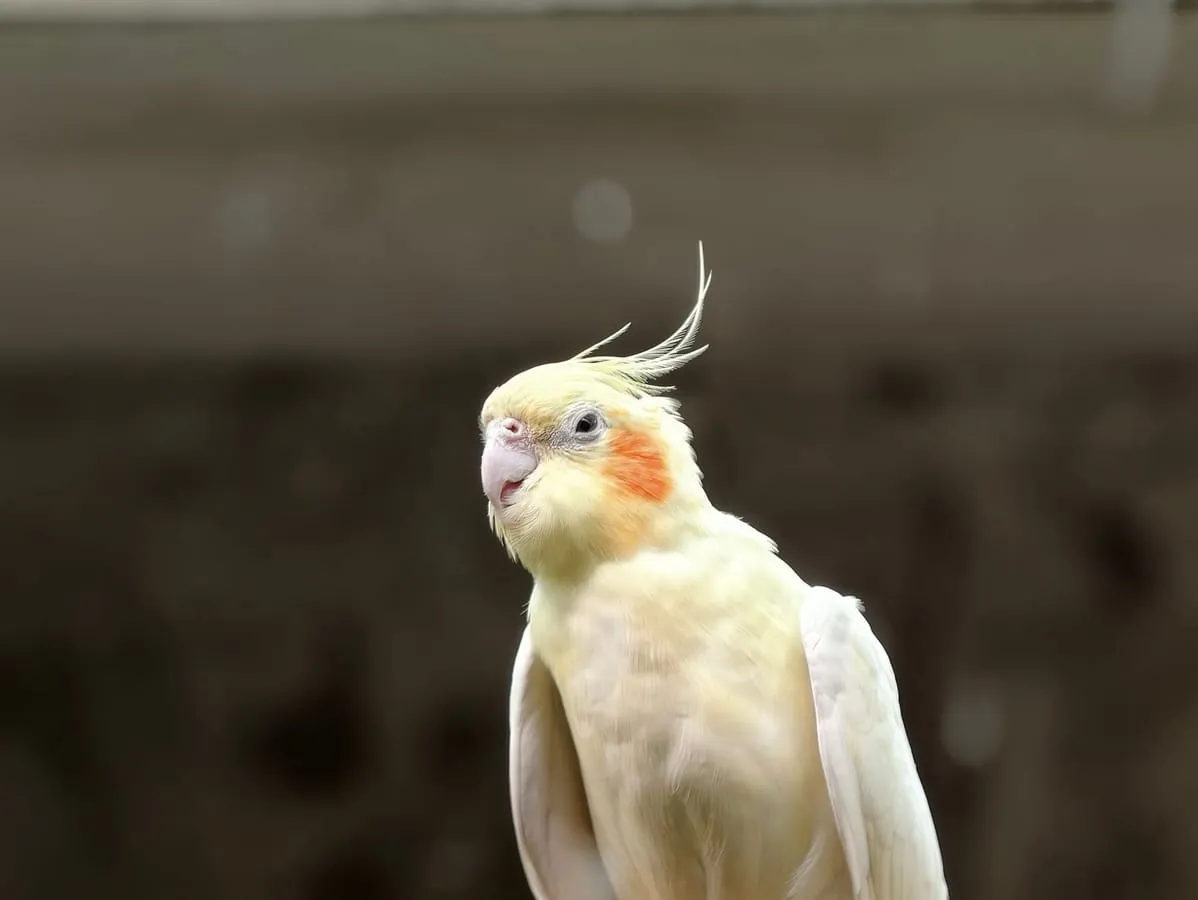
It sits early in a cockatiel’s warning sequence, often alongside a flattened, slicked-down posture, pinned or wide eyes, and a crest held low and tight against the head rather than relaxed or raised. Compare that to a calm, curious cockatiel, whose crest sits loosely upright and whose feathers look soft rather than clamped flat, and the difference becomes easy to spot. The hiss is rarely the opening move of an attack. It is far more often the whole message: stay back, I am not comfortable right now.
The situations that bring it out
Not every hiss means the same thing, but a handful of situations explain most of them.
A newly homed cockatiel hisses at the cage itself more than anything else, purely from the disorientation of a new home, new sounds, and a new person it has not yet learned to trust. Being cornered or reached for quickly, especially inside the cage where there is nowhere to retreat to, is the single most common trigger in birds of any age. Night frights and sudden noises can leave a cockatiel keyed up and quicker to hiss for a while afterward, covered in more detail in what are night frights in birds. Hormonal cockatiels, usually in spring, can also hiss and guard territory more than usual, often alongside other seasonal behaviour changes. And a cockatiel that hisses when handled in one particular spot, or that seems otherwise flat and quiet, is worth treating as a possible pain or illness signal rather than a straightforward behaviour issue.
What not to do when your cockatiel hisses
The instinct to keep going, especially if you were only reaching in for food or water, is understandable, but pressing on teaches your bird that hissing is not an effective way to ask for space, and a bite becomes the next tool it reaches for instead. The better move is small and boring: pause, give a little distance, and let your bird settle before trying again.
Building trust so the hissing fades
Patience and short, low-pressure sessions do more here than any single trick.
Spend time near the cage without demanding interaction, just being present while you read or watch TV, so your cockatiel gets used to you as background rather than a threat that only appears to grab it. When you do interact, keep sessions short and end them calmly before your bird gets overwhelmed, rather than pushing until a hiss shows up. A stick of spray millet offered from a short distance gives a nervous or new cockatiel a reason to approach you on its own terms instead of being reached for, which tends to speed trust-building considerably. The full step-by-step approach is covered in how to get your bird to trust you, and it applies just as well to a hissing cockatiel as to any other nervous bird.
A cockatiel that hisses a lot now is not a difficult or aggressive bird, it is usually just a scared or unsettled one that has not yet learned you are safe. Respect the warning when you hear it, keep sessions short and calm, and let trust build at your bird’s pace rather than yours. Most cockatiels hiss far less, sometimes almost never, once that trust is in place.
Related questions
Common questions
- Why does my new cockatiel hiss at me when I go near the cage?
- A recently homed cockatiel hissing at the cage is almost always fear rather than aggression. It has lost every familiar landmark, the cage, the room, the sounds, the person, all at once, and hissing is the cheapest way it has to ask for space while it works out whether you are safe. This usually fades over one to three weeks of calm, low-pressure time near the cage without forcing contact.
- Is my cockatiel hissing and biting at the same time a worse sign?
- It means the warning has escalated, not that your bird has suddenly turned aggressive. A hiss is nearly always the first step, and a bite that follows it is usually a sign the hiss was ignored, a hand kept coming after the bird had already asked it to stop. Respecting the hiss the moment you hear it is the single best way to keep bites from happening at all.
- Should I back away every time my cockatiel hisses at me?
- Yes, in the moment. Backing off when you hear a hiss is not letting your bird win, it is honouring the warning it gave you instead of forcing the interaction to a bite. Over days and weeks, short, calm, low-pressure sessions where your bird chooses to engage build trust far faster than pushing through hisses ever will.
- Will my cockatiel ever stop hissing completely?
- Most hand-tamed cockatiels settle into rarely hissing at their regular person, though almost any cockatiel will still hiss at something genuinely startling, a vet visit, a new pet, a stranger reaching in fast. The realistic goal is a bird that hisses far less often and only when it has real reason to, not one that never makes the sound again.