The first year of owning a dog costs more than any year that follows, because it carries the setup kit and a one-off run of veterinary work on top of the normal running costs. Expect roughly one and a half to two times a typical later year, before the purchase or adoption price. Where you live, how big the dog is and how you insure move that a great deal.
That is the shape of the answer. What follows is where the money actually goes, which parts you can influence, and which ones are simply the price of doing it properly.
Costs differ enormously between countries, between city and countryside, and between a terrier and a Great Dane, so everything here is framed as a planning range rather than a figure to quote. If you want a number to hold in your head, take the ongoing annual cost you can find in our true cost of owning a dog guide and assume the first year sits well above it.
Why year one is the expensive one
Several costs happen once, at the start, and then never again. That is the whole reason the first year stands out.
The initial vaccination course, microchipping and neutering are all first-year veterinary items that do not repeat. The kit is the same story: a crate, a bed, bowls, a collar, a lead, a harness and the first toys are bought once, even if a growing puppy means buying the collar and harness twice. Training classes, which are one of the better things you can spend money on, usually sit in the first six months. Add all of that to the ordinary food, insurance and preventive treatment costs that carry on forever, and year one lands high. From year two the picture flattens out into food, insurance, an annual health check and parasite treatments, which is a far steadier number.
The setup kit
The kit is the most visible first-year cost and the easiest one to overspend on, which is the good news, because it is also the one you control.
The genuinely necessary list is short: a crate or pen, a washable bed, bowls, food, a collar with an identity tag, a lead, a harness, one or two safe chews, and cleaning supplies. Bought sensibly, that is a modest share of the year. Bought as a full trolley of puppy-aisle products, it can quietly become one of the larger lines. The rule that saves the most money is to buy the cheap version of anything your puppy will outgrow and the good version of anything they will keep, and our guide to what you actually need for a new puppy and what you can skip goes through that list item by item.
Two things are worth spending properly on because they last: a folding crate with a divider, which covers the whole of puppyhood instead of being replaced, and a plain fixed training lead, which will still be the right lead in ten years.
The veterinary year
This is the line people most often underestimate, and the one where saving money tends to cost money later.
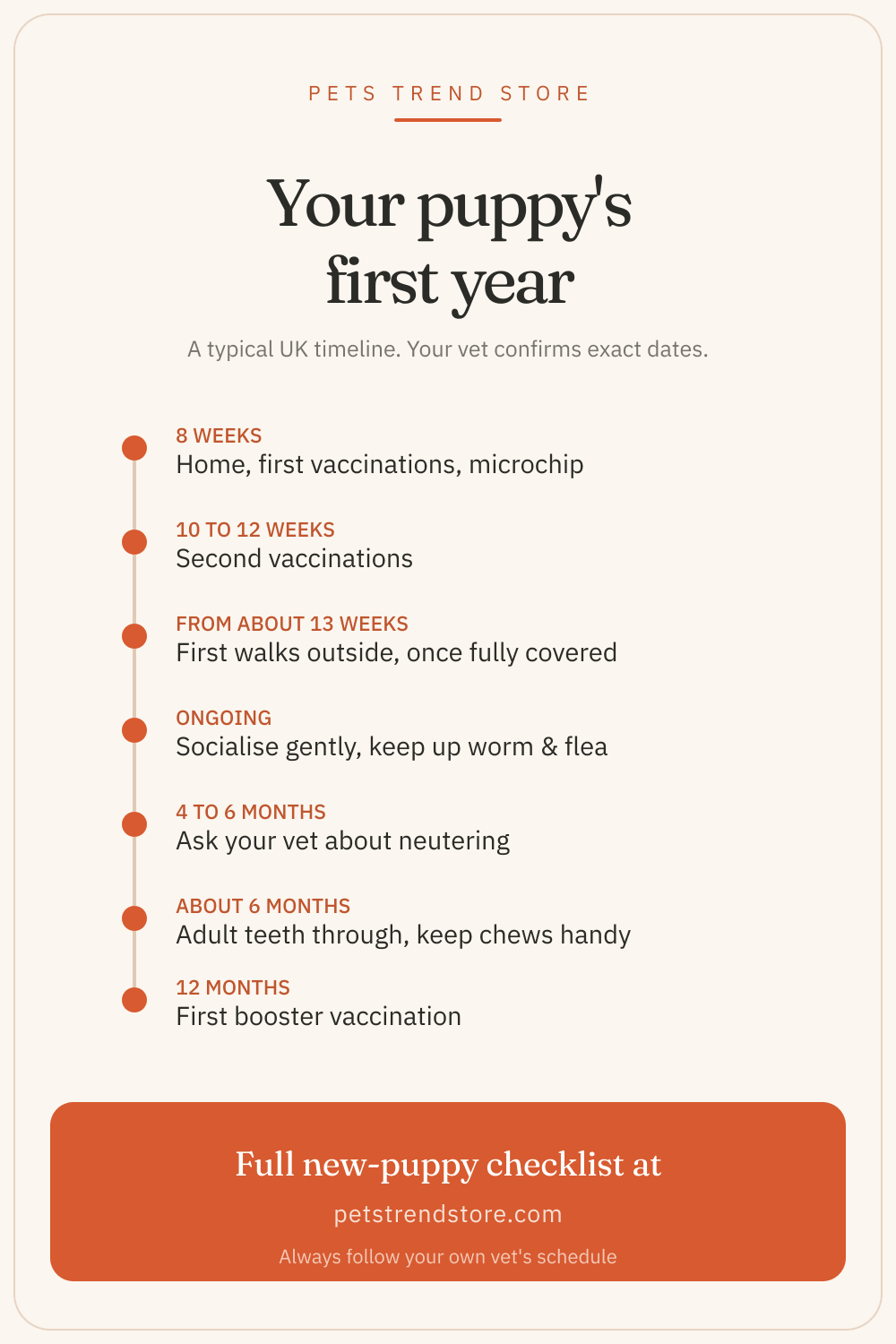
A first-year puppy needs a vaccination course, microchipping, regular worming and flea treatment, a neutering conversation and usually the procedure itself, and at least one health check. None of these is optional care. The dates vary by country and by practice, and your vet confirms the actual schedule, but the pattern is consistent: a cluster of appointments in the first six months, then a settled annual rhythm. Many practices sell a monthly health plan that spreads vaccinations, checks and parasite treatment across the year, which does not usually reduce the total but does make it predictable, and predictable is worth something when a puppy is new.
Insurance, or a deliberate buffer
Insurance is the cost that most changes the shape of a dog’s whole financial life, and the first year is the cheapest and easiest time to arrange it.
A policy taken out on a healthy young dog covers whatever comes later. A policy taken out after a limp, a skin problem or a stomach condition has already appeared normally excludes it as pre-existing, and those exclusions follow the dog. Premiums also rise with age, so the first year is the low point rather than the level you should expect to keep paying. Read what the policy actually does: lifetime cover behaves very differently from a policy that resets its limit each year or stops covering a condition after twelve months, and the cheapest premium is often the one that will not be there when you need it.
If you choose not to insure, the honest alternative is a real savings buffer that you pay into every month and do not touch, sized for a serious emergency rather than a routine bill. What does not work is having neither.
The costs people forget
A handful of first-year costs are genuinely easy to leave off a budget, and together they are not small.
Training classes are the main one, and they are among the best value in the whole list. Dog walking or daycare matters the moment you go back to a normal working pattern, and it is a monthly cost, not a one-off. Boarding for a holiday that was booked before the puppy arrived catches people every summer. The first collar and harness will be outgrown and replaced. There are poo bags, a treat pouch if you are doing the training properly, and the slow drip of treats used in that training. And if you claim on insurance, there is an excess to pay on the claim.
What genuinely lowers the first-year bill
Some savings are real and some are false economies, and it is worth knowing which is which.
Adopting rather than buying is the single biggest legitimate saving, because rescue fees are far below breeder prices and most rescues neuter, vaccinate and microchip before rehoming. Choosing a dog whose size and coat suit your budget is the next: a large dog eats considerably more than a small one for its whole life, and a coat that needs professional grooming every few weeks is a standing appointment, not a one-off. Buying the kit sensibly, insuring early, keeping the dog lean, and staying on top of cheap preventive care all pay off. Starting dental care in puppyhood costs very little and heads off one of the more common adult problems.
The false economies are skipping vaccinations, skipping insurance without a savings plan behind it, skipping training classes and paying a behaviourist later, and buying a puppy from whoever is cheapest. That last one is the expensive mistake: a badly bred puppy from a seller who does not health test can carry problems that cost far more than the difference in price, for the whole of the dog’s life.
The honest bottom line
The first year of a dog is front-loaded, and knowing that in advance is most of the battle. Budget for the setup kit, the veterinary course and the insurance as three separate things, keep the monthly running costs comfortable rather than borderline, and treat the purchase price as the least significant number in the plan.
If you are still deciding, how to choose the right dog for your life is the place to start, and our new puppy checklist maps the first twelve months so nothing arrives as a surprise. For the whole-life picture, the true cost of owning a dog carries the same question across a full fourteen years.
Common questions
- How much does a dog cost in its first year?
- Plan for the first year to run noticeably higher than a normal year, because it carries the setup kit and the one-off veterinary course on top of the ordinary running costs. In the UK, a realistic planning range for that first twelve months sits somewhere around one and a half to two times a typical later year, before the purchase or adoption price. Figures vary a great deal by country, by the size of the dog and by how you choose to insure, so treat any range as a planning figure rather than a quote.
- Why is the first year more expensive than the years after it?
- Because several costs happen once and then stop. The initial vaccination course, microchipping, neutering, the crate, bowls, bed, collar, harness and lead, and usually a set of training classes all land in the first twelve months. From year two onward you are mostly paying for food, insurance, preventive treatments and an annual check, which is a steadier and lower number.
- What is the biggest first-year cost for a dog?
- For most households it is the combination of food, insurance and the one-off veterinary work, rather than the purchase price. Insurance is the one people underestimate most, because a policy taken out on a healthy puppy is far easier and cheaper to hold than one taken out after a condition has already appeared.
- Is a rescue dog cheaper in the first year?
- Usually yes, and by a meaningful margin. Adoption fees are far below breeder prices, and most reputable rescues neuter, vaccinate and microchip before rehoming, which folds several first-year costs into one fee. The ongoing costs are the same as for any dog, and an older rescue may have existing health needs, so the saving is real but it is not a saving on the whole lifetime.
- What first-year costs do people forget?
- Training classes, dog walking or daycare if you work away from home, boarding for a holiday booked before the puppy arrived, replacing the first collar and harness once the puppy outgrows them, and the insurance excess on the first claim. Poo bags, worming and flea treatment are small individually and add up across a year.
- Should I insure a puppy straight away?
- It is worth arranging cover before or as soon as your puppy comes home, and worth reading what the policy actually covers. Anything that has already shown itself is normally excluded as a pre-existing condition, so the cheapest and simplest time to insure is while the dog is young and healthy. Whether you insure or save deliberately into a buffer, the point is to have a plan for a large unexpected bill rather than hoping one does not arrive.