A cat’s first year costs more than any year that follows, because the setup kit and a one-off run of veterinary work sit on top of the normal running costs. As a planning shape, allow for roughly one and a half times a typical later year, before the kitten or adoption fee. Country, pedigree and insurance choices all move that considerably.
That is the honest shape of it. Cats are cheaper to keep than dogs, which is true and still leaves a real annual number, and the first twelve months is the year that number peaks. What follows is where the money actually goes.
Costs differ a great deal between countries and between households, so everything below is framed as a planning range rather than a figure to quote. For the whole-life picture, the true cost of owning a cat takes the same question across fifteen years or more, and the first year sits well above the average year in that guide.
Why year one is the expensive one
A handful of costs happen once, at the start, and never again. That is the entire reason the first year stands apart.
The initial vaccination course, microchipping and neutering are first-year veterinary items that do not repeat. The kit is bought once: litter trays, a scratching post, a carrier, bowls, a few toys and a supply of litter. Add those to the ordinary food, litter, insurance and preventive treatment costs that carry on forever, and year one lands high. From the second year the picture flattens into food, litter, insurance, parasite treatment and an annual check, which is a far steadier and more predictable number.
The setup kit
The kit is the most visible first-year cost and the easiest to overspend on, which is good news, because it is also the one entirely in your control.
The genuinely necessary list is short: litter trays, litter, a scoop, bowls, food, a carrier, a scratching post, a couple of toys and an enzyme cleaner. Our guide to what to buy before you bring a kitten home goes through it item by item, and the rule that saves the most money is to spend properly on the two things that decide the next fifteen years and go basic on everything else.
Those two are the litter tray and the scratching post. An open tray with low sides is what a small kitten can actually use, and a tall, heavy sisal scratching post is what stops the sofa becoming the alternative. A wobbly or short post gets replaced, and the damage done to furniture in the meantime costs more than the difference. A metal scoop is a one-time purchase that will outlast the cat.
The veterinary year
This is the line people underestimate, and the one where saving money tends to cost money later.
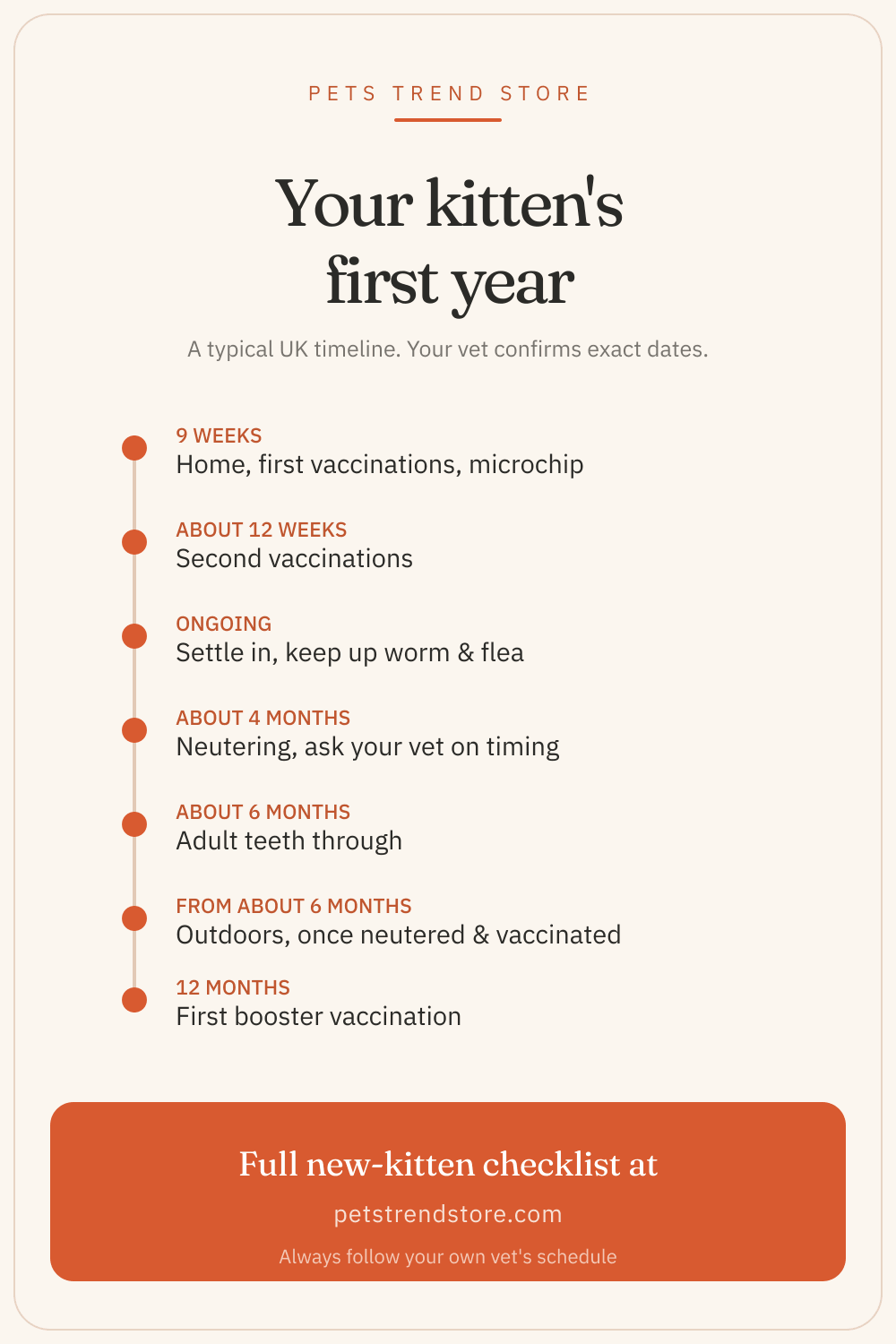
A kitten needs a vaccination course, microchipping, worming and flea treatment, neutering, and at least one health check in the first twelve months. Your vet confirms the actual schedule, which varies by country and practice, but the pattern is consistent: a cluster of appointments in the first six months, then a settled annual rhythm afterwards. Many practices offer a monthly health plan that spreads vaccinations, checks and parasite treatment across the year, which does not usually lower the total but makes it predictable.
Neutering deserves its own mention, because it is the first-year cost most often postponed and least worth postponing. Beyond the obvious, it removes a set of behaviours, spraying, roaming, fighting, that are unpleasant to live with and that carry their own veterinary bills in the form of bite abscesses and road injuries. In many places it is also the point at which a cat can safely start going outdoors.
The ongoing costs that start in year one and never stop
Four costs begin in the first month and then simply continue, and it is worth seeing them as monthly rather than annual.
Food is the obvious one, and the quality you settle on in the first year tends to be the quality you keep paying for. Litter is the one people forget: for an indoor cat it is a permanent monthly line, and it is a meaningful share of the total over a long life. Preventive treatment for fleas and worms carries on year-round. And insurance, if you take it, is a standing monthly payment that rises as the cat ages.
That last point is worth sitting with. The kitten premium is the cheapest that policy will ever be. Budgeting on the basis of the first-year quote and being surprised in year eight is one of the more common ways people end up dropping cover at exactly the age when a cat most needs it.
Insurance, or a deliberate buffer
The first year is the cheapest and simplest time to insure a cat, for one reason: the cat has no history yet.
A policy taken out on a healthy kitten covers whatever comes later. A policy taken out after a urinary problem, a dental issue or a skin condition has already appeared normally excludes it as pre-existing, and those exclusions follow the cat for life. Read what the policy actually does rather than comparing premiums alone, because lifetime cover behaves very differently from a policy that resets its limit annually or stops covering a condition after twelve months.
If you decide not to insure, the honest alternative is a real savings buffer you pay into every month and do not touch, sized for a genuine emergency rather than a routine bill. Cats are prone to a number of conditions over a long life, and a single serious episode can be expensive. What does not work is having neither a policy nor a buffer.
The costs people forget
A handful of first-year items are genuinely easy to leave off a budget.
The second litter tray is one, because the rule of thumb most behaviour people use is more trays than cats, and a household that planned for one usually ends up with two. Replacing a scratching post that turned out to be too short or too light is another. A cat sitter or boarding for a holiday booked before the kitten arrived catches people every summer. There is the insurance excess on a first claim. And there is the quiet cost of accidents: a chewed cable, a knocked-over lamp, a rug that needed replacing after a bout of house training.
What genuinely lowers the first-year bill
Some savings are real, and some are false economies.
Adopting rather than buying is the biggest legitimate saving, since adoption fees sit far below breeder prices and most rescues neuter, vaccinate and microchip before rehoming. Choosing a moggy over a pedigree lowers both the upfront cost and, in some breeds, the inherited health risk that drives insurance and veterinary costs later. Buying the kit sensibly, insuring early, keeping the cat at a healthy weight, and starting cheap preventive care all pay off across the whole life rather than just the first year.
The false economies are skipping vaccinations, delaying neutering, buying a scratching post that will not do the job, and choosing a scented budget litter that the cat quietly refuses to use, which is a far more expensive problem than it sounds once a cat starts going elsewhere.
Get the first year planned properly and the rest is a steady, manageable monthly number. Our new kitten checklist lays the twelve months out as a timeline so nothing arrives unexpectedly, and how to choose the right cat for your home is the place to start if you are still deciding.
Common questions
- How much does a cat cost in its first year?
- Expect the first twelve months to run noticeably above a normal year, because it carries the setup kit and a one-off run of veterinary work on top of the ordinary costs. As a planning shape, budget for roughly one and a half times a typical later year, before the purchase or adoption fee. The actual figure varies a great deal by country, by whether the cat is a pedigree, and by how you insure, so treat any range as a planning figure rather than a quote.
- Why is a kitten's first year more expensive?
- Because several things happen once and then stop. The initial vaccination course, microchipping and neutering all fall in the first twelve months, and so does the kit, which is litter trays, a scratching post, a carrier, bowls and toys. After that you are mostly paying for food, litter, insurance, preventive treatments and an annual check, which is a steadier and lower number.
- What is the biggest first-year cost for a cat?
- For most households it is the combination of food, litter, insurance and the one-off veterinary work rather than the price of the kitten. Litter surprises people because it is a constant monthly cost for an indoor cat and it never stops, and insurance surprises people because the cheap kitten premium is not what they will be paying in a few years.
- Is a rescue kitten cheaper in the first year?
- Usually considerably cheaper to take on, because adoption fees sit far below breeder prices and most reputable rescues neuter, vaccinate and microchip before rehoming, which folds several first-year costs into one fee. The ongoing costs are the same as for any cat, so the saving is real but it applies mainly to that first year.
- What first-year costs do people forget?
- Litter as a permanent monthly line, neutering if it is not already done, the second litter tray that most households end up needing, replacing a scratching post that turned out to be too small or too wobbly, a cat sitter for a holiday booked before the kitten arrived, and the insurance excess on a first claim. Individually small, collectively not.
- Should I insure a kitten straight away?
- It is worth arranging cover as the kitten comes home, and worth reading what the policy actually covers rather than only comparing premiums. Anything that has already appeared is normally excluded as pre-existing, so a healthy kitten is the easiest and cheapest thing to insure. If you choose not to insure, the honest alternative is a savings buffer you pay into monthly and do not touch.