A bored dog is a busy dog, and the job it picks is rarely the one you would choose. Skirting boards, cushions, the corner of the sofa, your left shoe. When people ask me for “the best toy” to stop this, they are usually picturing something indestructible. The toys that actually help are the opposite of a passive thing to gnaw. They give a dog a task.
That distinction matters, so it is worth being clear about it before you spend any money. A toy that just sits there to be chewed gets destroyed because chewing is the only thing it offers. A toy that makes your dog sniff, lick, nudge, and think gives the brain something to do, and a dog that has used its brain settles instead of going looking for trouble.
Match the toy to your dog first
Before any specific pick, work out what kind of chewer you have, because it changes everything you should buy.
Some dogs mouth a toy gently and lose interest. Some give it a proper workout but stop at the seams. And some are demolition experts who can take a “tough” toy apart in an afternoon. Buy for the dog in front of you, not the one on the packaging. A power chewer handed a soft plush toy will have the stuffing out in minutes and may swallow some, which is how you end up at the vet rather than saving money.
Size matters too. A toy small enough to sit fully inside the mouth is a choking risk, so size up if you are unsure.
The workhorse: a stuffable rubber toy
If you buy one thing, buy a stuffable rubber toy, and learn to use it properly. This is the toy I reach for most, because it turns your dog’s normal food into a project. You pack it with part of their meal, they spend twenty minutes getting it out, and that is twenty minutes they are not redecorating your hallway.
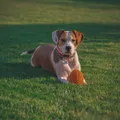
KONG
KONG Classic Dog Toy
- Material Natural rubber
- Sizes XS to XXL
- Stuffable Yes, freezer safe
- Best for Boredom and light to medium chewers
Why we picked itThe one enrichment toy we would buy first. Stuff it, freeze it, and a bored dog has a proper job for half an hour.
The trick is difficulty. Stuff it loosely the first few times so your dog gets quick wins and learns the toy is worth bothering with. Once they have the idea, pack it tighter, and then freeze it. A frozen stuffed toy can keep a determined dog occupied for half an hour, and it doubles as relief for a teething puppy.
Use part of their daily food rather than piling extra treats on top, so you are redirecting calories they were eating anyway, not adding a second dinner.
The thinking toy: a puzzle feeder
A puzzle feeder is a board or container with compartments and sliders that your dog has to move to uncover food. The point is mental work. Five minutes of figuring out a puzzle genuinely tires a dog more than a longer plod round the block, which is why these are gold on a rainy day or when your dog is recovering from something and cannot run around.
The mistake people make is starting too hard. Buy one rated for beginners, leave the lids off or the sliders open at first, and only raise the difficulty once your dog is succeeding. A dog that fails in the first minute decides the puzzle is not food and wanders off.
The calming toy: a snuffle mat
A snuffle mat is a piece of fabric with long fronds you scatter dry food into, so your dog has to sniff it all out. Sniffing is naturally calming for dogs, the canine equivalent of a slow, absorbing task, and a meal eaten nose-first leaves most dogs noticeably more settled than the same food bolted from a bowl.
It is also the easiest one to improvise. A rolled-up towel with kibble tucked in the folds, or a muffin tin with food under tennis balls, does the same job while you decide whether to buy the real thing.
The serious chew for power chewers
Some dogs need to chew, full stop, and denying that just sends them to the furniture. For those dogs you want a chew toy built for it: solid rubber, the kind that flexes slightly rather than shatters. Look for one rated specifically for strong or “power” chewers, and check it has no small parts to break off.
Even the toughest toy is not truly indestructible, so supervise at first and bin anything that starts to come apart. A toy doing its job and wearing out slowly is fine. A toy losing chunks is not.
Using toys so they keep working
Buying the toy is the easy part. The dogs who stay out of trouble are the ones whose owners use the toys well.
Rotate them. Keep three or four out and the rest in a cupboard, then swap every few days, and an old toy comes back interesting. Give the enrichment toys before you leave the house, not after you get home, so the busy, settling part happens during the stretch your dog usually struggles with. And pair toys with a tired dog where you can: a stuffed toy after a real walk lands far better than one offered to a dog with a full tank of energy.
When toys are not the answer
Be honest with yourself about the pattern. If the chewing happens at all hours and your dog simply likes destroying things, this is a boredom and outlet problem, and the toys above will carry most of the load. The same approach is what stops a puppy shredding its bed.
But if the damage only happens when your dog is left alone, and comes with drooling, pacing, scratching at doors, or distress, that points to separation anxiety rather than boredom. No toy fixes that on its own, and a stuffed toy can even go untouched because the dog is too worried to eat. That one is worth a proper plan, and sometimes a vet or behaviourist, rather than another trip to the toy aisle.
Common questions
- What toy keeps a dog busy the longest?
- A rubber toy stuffed with food and then frozen wins almost every time, because the dog has to lick and work for twenty to thirty minutes instead of chewing through something in two. Snuffle mats and puzzle feeders come next, for the same reason, since they make the dog work for the reward.
- My dog destroys every toy within minutes. What can I do?
- Match the toy to how hard your dog actually chews, supervise the first few sessions with anything new, and accept that some toys are meant to be chewed down and replaced. If the destruction only happens when you leave, the issue is more likely boredom or anxiety than the toy itself.
- Are puzzle toys actually worth it?
- For most dogs, yes. A few minutes of problem solving tires a dog out more than a longer walk. The catch is difficulty. Start far easier than you think, because a dog that cannot crack it in the first minute usually walks away and does not come back.
- How many toys should my dog have out at once?
- Fewer than you would expect. Keep a small set in rotation and put the rest away, swapping them every few days. A toy that vanished last week is far more interesting than one that has been on the floor for a month.