A puppy needs four kinds of toy: a stuffable rubber toy for enrichment and teething relief, one safe chew, one thing to tug or carry, and one thing that moves for chase games. That is it. Buy two or three to start with, add slowly once you see what your puppy likes, and rotate them rather than leaving everything out.
The basket of toys people buy before a puppy arrives is mostly for the owner. What a puppy actually needs is far narrower, and it changes as they grow, so this guide works through the four jobs a toy can do, what to buy for each, and the materials that do genuine harm to a young mouth.
Why four kinds, and not more
Toys are not a single category. A toy either gives a puppy something to chew, something to think about, something to carry, or something to chase, and a collection that covers all four is worth far more than a dozen toys that all do the same thing.
Most people’s puppy haul is really one job repeated: a pile of plush squeaky animals, all offering the same short burst of shake-and-squeak. The puppy loses interest, the owner buys more, and the chewing goes into the furniture anyway because nothing in the basket satisfied the actual need. Buying for the four jobs instead means a smaller collection that keeps working, and it costs less.
The one to buy first: a stuffable rubber toy
If you buy one toy before the puppy comes home, make it this one. It covers two of the four jobs at once and it is the toy that does the most to keep a puppy out of trouble.
KONG
KONG Classic Dog Toy
- Material Natural rubber
- Sizes XS to XXL
- Stuffable Yes, freezer safe
- Best for Boredom and light to medium chewers
Why we picked itThe one enrichment toy we would buy first. Stuff it, freeze it, and a bored dog has a proper job for half an hour.
The point is not the rubber, it is what you put inside it. Packed with part of the daily food ration, it turns a two-minute meal into a twenty-minute project, and a puppy working at food is a puppy not working at the skirting board. Stuff it loosely the first few times so your puppy gets quick wins and learns the toy is worth the effort, then pack it tighter as they get the idea.
Then freeze it. A frozen stuffed toy lasts considerably longer and the cold is genuine relief for a sore teething mouth, which is the single stretch of puppyhood where most furniture damage happens. Give it at the moments that are usually difficult: when you leave the room, when the family is eating, in the early evening when a lot of puppies get wild.
The chew, and the materials to avoid
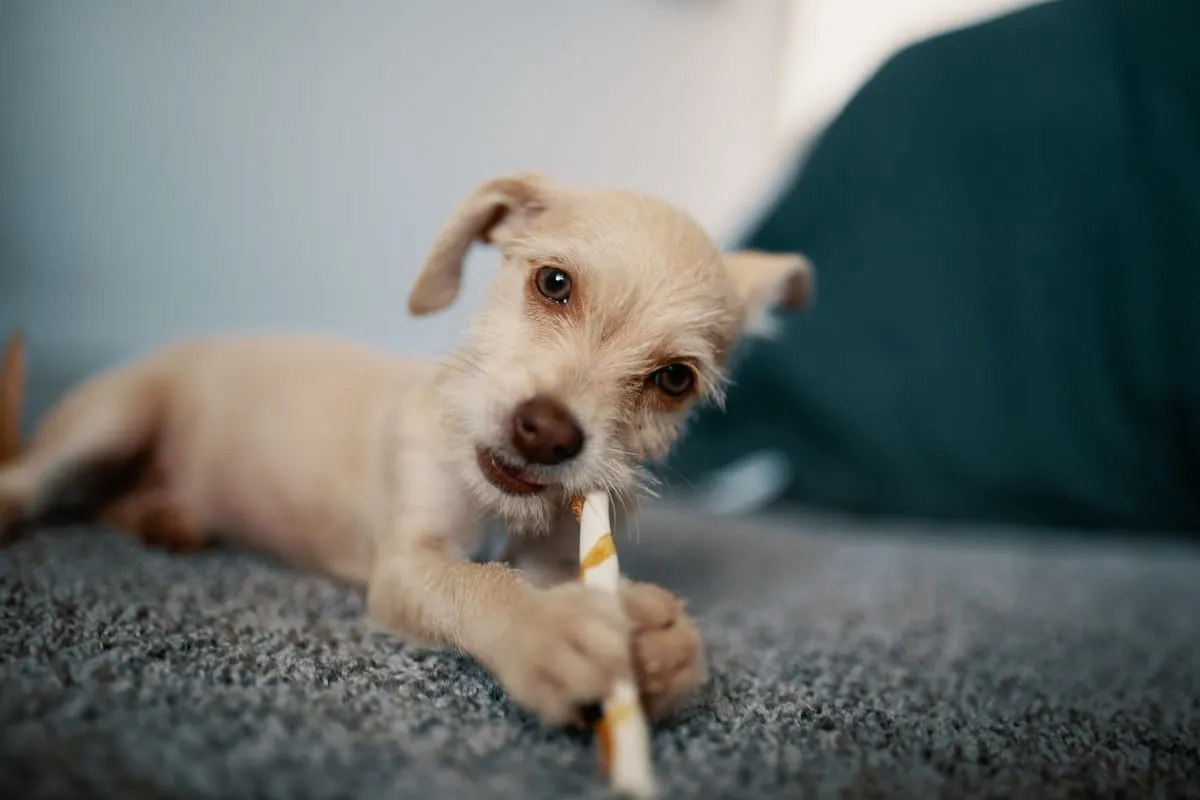
Puppies chew because they are teething and then because they are dogs. Denying the behaviour just sends it to the furniture, so the job is to give it somewhere legitimate to go.
Buy a chew sold specifically for puppies rather than one aimed at adult power chewers, because the harder adult versions are made for jaws a puppy does not have yet. Soft natural rubber is the safest starting point. As your puppy grows into stronger chewing you can move up through tougher rubber or a nylon chew in a real strength grade, sizing up rather than down, since a toy small enough to sit fully inside the mouth is a choking risk.
The thinking toy, once they are ready
A puppy’s brain tires faster than its legs, which is genuinely useful in the weeks before walks can start and on days when the weather rules out anything long.
A snuffle mat is the easiest place to begin. Scatter part of a meal into the fabric fronds and let your puppy sniff it out, because sniffing is naturally settling for dogs and a meal eaten nose-first leaves most puppies noticeably calmer than the same food bolted from a bowl. A slide-and-lift puzzle is the next step up, and the mistake everyone makes is starting too hard. Leave the lids off at first, let your puppy succeed immediately, and only add difficulty once they are winning, because a puppy that fails in the first minute decides the puzzle is not food and walks away.
You can improvise both. A rolled towel with kibble in the folds, or a muffin tin with food under tennis balls, does the same job while you decide whether to buy the real thing.
Something to carry, and something to chase
The last two jobs are the social ones, and they matter more for the relationship than for the toy box.
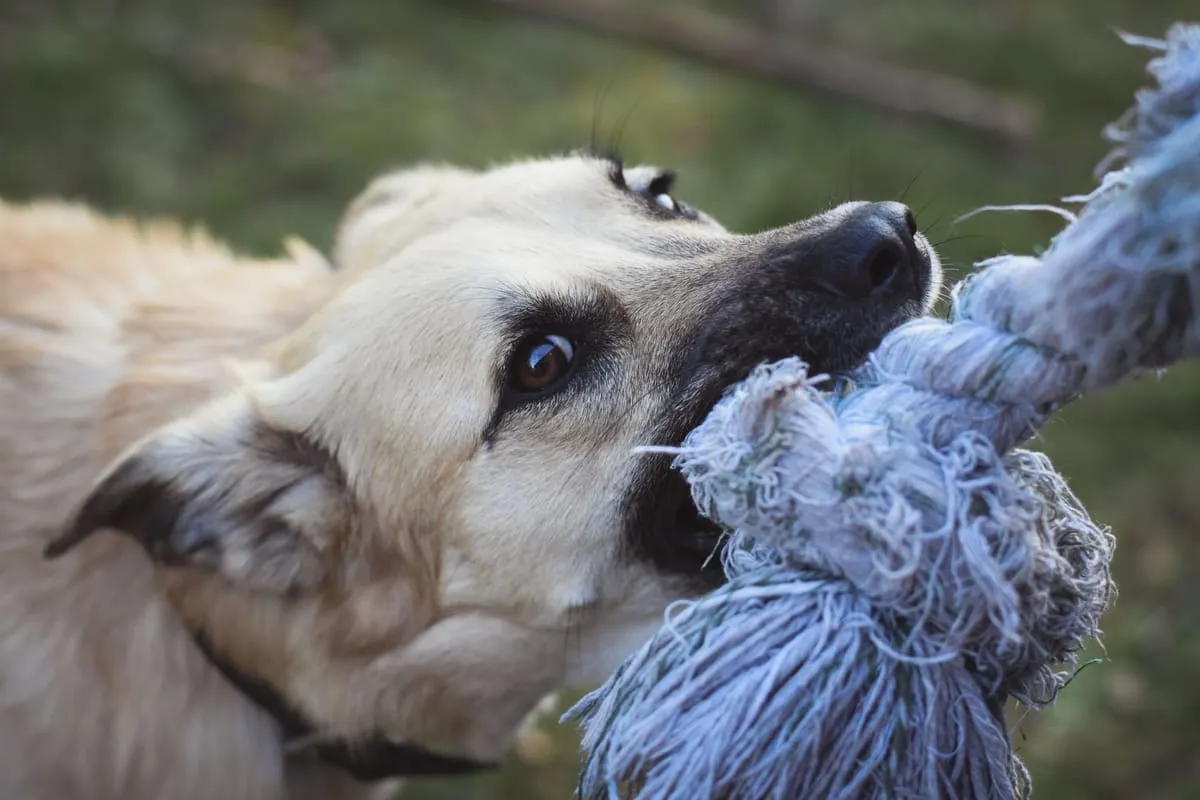
Something to carry and tug gives you a game you can play together, which is one of the better ways to build a bond and to teach a reliable swap. A rope toy works for this, supervised, and retired once it starts to fray, since swallowed rope strands are a real problem. Tug is not, despite the old story, a game that makes dogs aggressive: it is a cooperative game, and it is one of the most useful rewards you have once your puppy will let go on cue.
Something that moves covers the chase drive. A tough rubber ball is kinder to teeth than a tennis ball, whose abrasive covering wears enamel down over time, and it is worth keeping fetch short and on soft ground while a puppy’s joints are still growing. Repeated hard sprinting, sharp turns and jumping are not a good idea for a young dog, whatever their enthusiasm suggests.
Using toys so they keep working
The buying is the easy half. What decides whether a puppy is destructive is mostly how the toys are used.
Give the enrichment toys before the difficult stretch rather than after it, so the busy, settling activity happens while your puppy would otherwise be getting into trouble. Pair a stuffed toy with a puppy who has already had some exercise, since a toy offered to a dog with a full tank of energy tends to be ignored. Keep the rotation going. Check every toy once a week and bin anything shedding pieces. And accept that some toys are consumables: a chew that wears down slowly is doing exactly what you bought it for.
If the destruction is happening only when your puppy is left alone, and comes with distress rather than boredom, that is a different problem and no toy solves it on its own. The same is true of a puppy that will not engage with any toy at all, which our guide to a dog that will not play works through in detail. For the wider kit list, what you actually need for a new puppy and what you can skip covers everything else that goes on the shopping list, and why a puppy destroys its bed tackles the most common casualty of a teething mouth.
Common questions
- How many toys does a puppy need?
- Four kinds, not four dozen items. A stuffable rubber toy for enrichment and teething relief, one safe chew, one thing to tug or carry, and one thing that moves for chase games. Keep two or three out at a time and rotate the rest, because a small changing set holds a puppy's interest far better than a full basket that never changes.
- What toys are safe for a teething puppy?
- Things with some give in them. Soft natural rubber, rubber toys that can be stuffed and frozen, and chews sold specifically for puppies rather than adult power chewers. The quick test is your thumbnail, and if you cannot make a dent in it, it is too hard for a puppy's mouth. Antlers, hooves, hard nylon bones and real bones crack teeth, and a chipped tooth in a young dog is a genuine veterinary problem.
- Is it safe to give a puppy a soft toy?
- For many puppies, with supervision. The risk is the stuffing and the squeaker rather than the fabric, because a puppy that opens a seam may swallow what is inside. Supervise the first few sessions with anything plush, take it away once a seam goes, and if your puppy is a determined shredder rather than a carrier, skip plush toys entirely and use rubber instead.
- How do I stop my puppy chewing furniture instead of toys?
- Give the chewing somewhere legitimate to go and manage the rest. Have a safe chew available at all times, use a pen or a gate so the puppy is not loose in a room full of chair legs unsupervised, and swap rather than scold when they start on something wrong. Teething runs for months, so the goal is to redirect it rather than to stop it.
- When should I replace a puppy toy?
- As soon as it starts losing pieces. A toy wearing down evenly is doing its job, but a toy shedding chunks, with a split seam, an exposed squeaker or a chewed-through end, is a swallowing risk and should go in the bin. Check toys over once a week, and size up any toy small enough to fit fully inside the mouth.