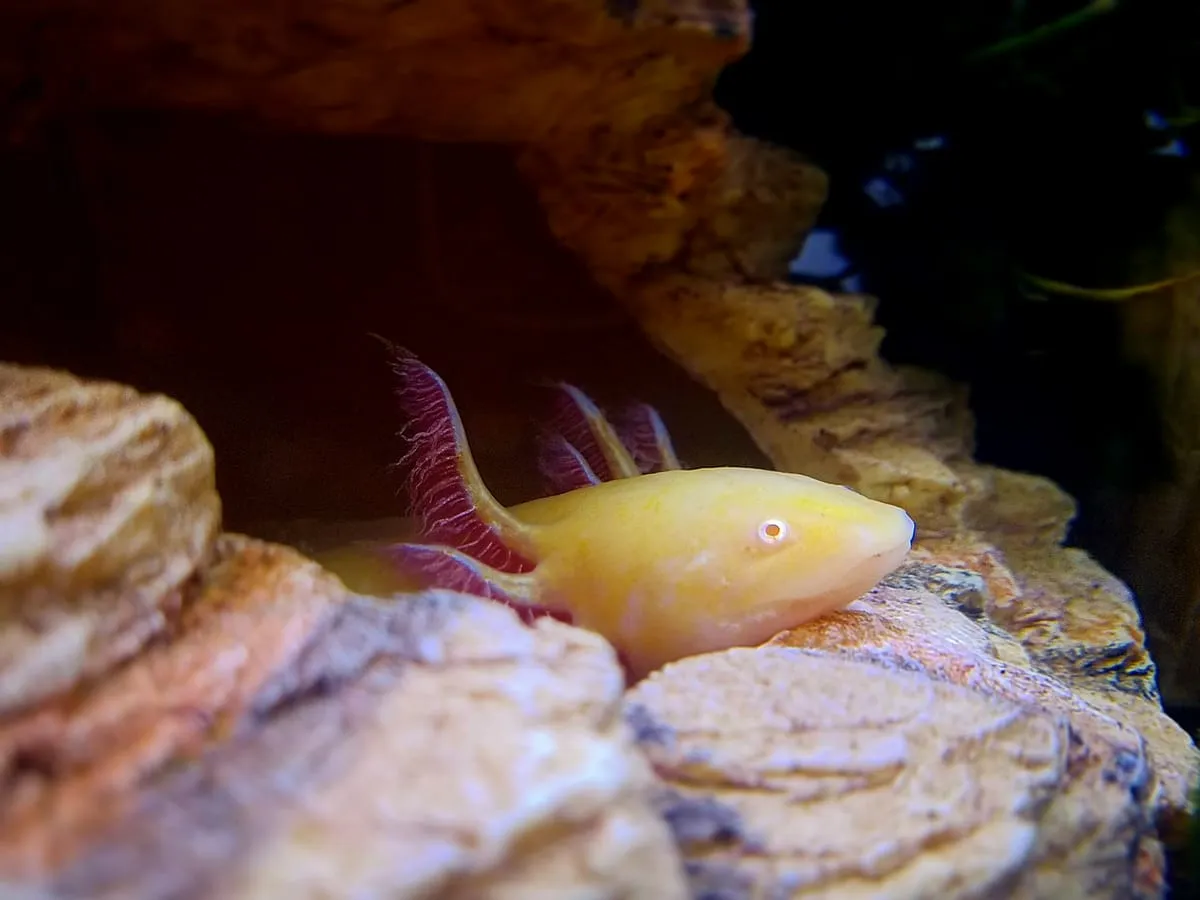
Gills curling forward over an axolotl’s head are usually a stress posture rather than a disease by themselves, most often tied to ammonia, nitrite, a temperature that has crept up, or water flow hitting the gills too directly. Some axolotls also naturally carry a slight forward lean in otherwise healthy gills, so a calm, eating axolotl with gills pointing forward is not automatically in trouble.
It is still worth taking seriously the first time you notice it. Gills are the one part of an axolotl that sits in direct, constant contact with the water, with nothing protecting the tissue, so they tend to be the first thing to react when something in the tank has shifted. The good news is that the list of likely causes is short and mostly testable within a few minutes.
Why this looks more alarming than it usually is
An axolotl’s external gills, the feathery stalks either side of its head, are blood-rich tissue doing the job of lungs, pulling oxygen straight from the surrounding water. Anything that stresses an axolotl tends to show up there first and most visibly, well before it shows up anywhere else, which is exactly why gills pointing forward catches an owner’s eye immediately.
That sensitivity is useful information, not just a scare. A sudden change in gill posture is your axolotl telling you something in its environment has moved before you would otherwise notice. The job is to work out what, rather than to assume the worst from the shape alone.
Test the water before anything else
Ammonia and nitrite are the two numbers to check first, since both are strong irritants that damage gill tissue directly and are by far the most common reason gills curl forward. A newly set up tank that has not finished cycling is the classic setting for this, but an established tank can spike too, after overfeeding, a dead plant rotting unseen, or simply too much axolotl for the filter’s current capacity.
If ammonia or nitrite comes back anything above zero, a partial water change with a dechlorinator that also detoxifies ammonia, such as Prime, is the fastest way to take the pressure off the gills while you work out the longer-term fix. It buys time, it does not replace solving why the number rose in the first place.
Temperature and flow matter just as much
Axolotls are a cool-water species, comfortable in the high teens Celsius, roughly 60 to 68 Fahrenheit, and they start showing stress well before water feels obviously warm to a human hand. A tank that has crept up a few degrees over summer, or that sits somewhere that catches afternoon sun, can be enough on its own to push gills into that forward curl even with clean water underneath.
Filter flow is the other common trigger. Axolotls evolved for still water, not the current most aquarium filters are built to produce, and an outflow aimed directly at where an axolotl rests can physically push the gills forward and keep them there. Baffling the output with a sponge or redirecting it at the glass rather than open water usually settles this within a day.
When forward-pointing gills are just how this axolotl is built
Not every case is stress. Individual axolotls vary a fair amount in how their gills naturally sit, and some, particularly ones with longer gill filaments, carry a bit of forward curve even when completely healthy. The angle an axolotl happens to be resting at, or water movement passing over it in the moment you look, can also make gills appear more curled than they are on average.
The way to tell the two apart is everything else about the axolotl, not the gills in isolation. A calm, steady swimmer that is eating normally, holding its usual color and not spending unusual time at the surface is very likely just an axolotl with a naturally forward gill set. One that is also listless, off its food, pale, or hanging near the surface is telling a different story, and that is the one worth testing water and checking temperature for straight away.
The fast version
Test ammonia and nitrite first, check the actual water temperature rather than guessing, and look at whether the filter outflow is hitting your axolotl directly. Most forward gill curling traces back to one of those three things, and most of it settles within a day or two once the underlying water problem is fixed. An axolotl that is otherwise bright, eating and swimming normally with gills that simply point forward is probably just built that way, but testing the water costs five minutes and rules out the alternative for certain.
Related questions
Common questions
- Why are my axolotl's gills curling forward?
- Forward-curling gills are a stress posture, and the most common trigger by far is water quality, ammonia or nitrite that has crept up, a temperature that has drifted warm, or filter flow hitting the gills too directly. It is a signal to test the water and check the thermometer, not a diagnosis on its own, since the same posture shows up for several different underlying causes.
- My axolotl's gills are pointing forward but it seems otherwise fine, should I worry?
- Not necessarily. Some axolotls naturally carry a bit of a forward lean in healthy gills, and water current or the angle an axolotl is resting at can make gills look more curled than they really are. A calm axolotl that is eating, moving normally and holding good color alongside forward-pointing gills is more likely just built that way than in active distress, though testing the water is still worth doing to rule it out.
- What should I check first if my axolotl's gills are curled?
- Test ammonia, nitrite and nitrate with a liquid test kit before changing anything else, since those three numbers rule in or out the single most common cause fastest. Check the actual water temperature with a thermometer rather than trusting a dial, and look at where the filter outflow points relative to where your axolotl tends to sit.
- When does curled gills mean I need to get my axolotl checked by a vet?
- See an exotics or aquatic vet if the gills look ragged, patchy, white or fuzzy rather than simply curled, if your axolotl is gasping at the surface, floating unnaturally, refusing food for more than a couple of days, or if a bad water test does not improve within a day of water changes. Those point toward gill damage or infection rather than a passing stress posture, and they need more than a water fix.