A dog that will not touch its toys gets a whole guide written about it. A reptile that sits in the same corner of its tank all day mostly gets left alone, because reptiles do not chase, fetch, or shred anything, and it is easy to assume that means they have no inner life to occupy. That assumption is not quite right. A bearded dragon, snake, or gecko is never going to bat a ball around, but the enclosure it lives in can still be more or less able to support the things that species actually does all day in the wild, and getting that right changes how the animal behaves.
What “bored” actually means for a reptile
The word does not translate directly from a dog or a parrot, so it helps to be precise about what is really being asked here.
A reptile is not going to destroy a sofa or scream from frustration the way an under-stimulated mammal or bird will. What a flat, empty enclosure actually costs a reptile is choice. In the wild, even a sedentary species like a ball python moves between different microclimates through the day, chooses cover based on how exposed it feels, and investigates new smells and textures as they appear. A bare tub with one hide and a water bowl removes almost all of that choice. The animal survives fine. It just spends its life making one decision instead of dozens, and our guide to what your reptile’s behaviour is telling you covers how that shows up as glass surfing, pacing, or a reptile that hides constantly rather than using its space normally. Enrichment, in a reptile context, mostly means giving those choices back.
Vertical space and things to climb
The single change that does the most for the widest range of species is adding height, because most keepers set an enclosure up as a floor plan and stop there.
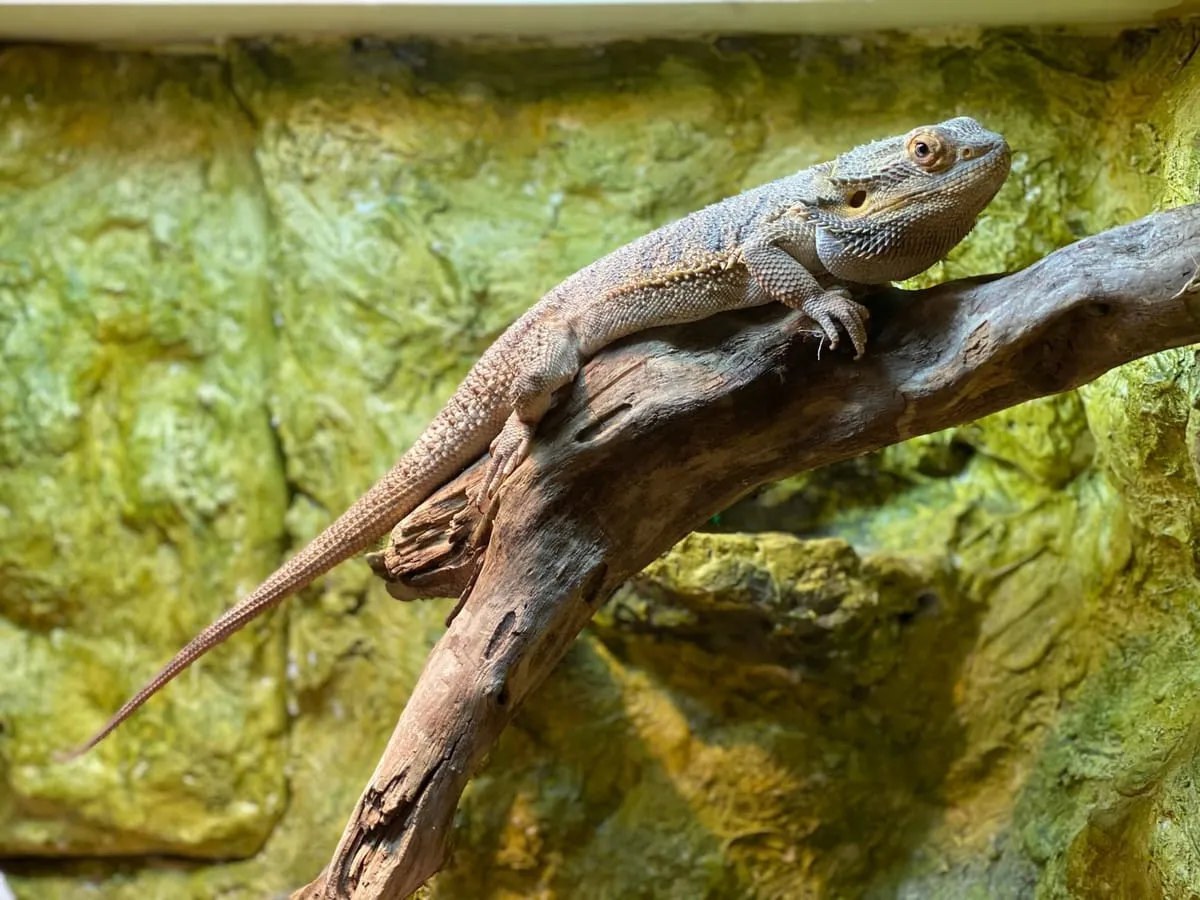
Arboreal and semi-arboreal species, crested geckos, many young bearded dragons, and various climbing lizards, use height constantly when given it, basking higher up, exploring branches, and resting off the ground where they would naturally feel more secure. A bendable climbing vine or a securely wedged branch turns a flat floor into a space with actual layers, and a suction-mounted basking hammock gives a raised, secure spot that bearded dragons in particular take to quickly. Even ground-dwelling species that will not climb far benefit from a low branch or rock to walk over and investigate, since texture and elevation changes are themselves a form of enrichment for an animal that otherwise crosses the same smooth floor every day.
A choice of hides, not just one
Cover is not optional for a reptile, every species needs it to feel secure, but one hide in one spot is the minimum, not the goal.
Give at least two hides, ideally more, placed at different points along the enclosure’s temperature gradient, so the animal can choose to feel secure and warm, or secure and cool, rather than picking one over the other. A simple wooden half-log hide works well at the cool end, while a humid hide like a moss-filled resin cave at the warm end supports shedding for species that need higher humidity to slough their skin cleanly. Rearranging hides occasionally, rather than leaving the layout completely static for years, also gives the animal something new to investigate without touching the temperatures or humidity it actually depends on.
Feeding as enrichment
How food arrives matters more than most keepers assume, and it costs nothing extra to change.
Placing food in the same bowl in the same spot every time turns feeding into a non-event. For insectivorous species, scattering feeder insects around the enclosure rather than presenting them in a dish lets the animal hunt the way it would naturally, which is a meaningfully different experience from food simply appearing. For species fed a powdered or gel diet, an elevated canopy feeding dish mounted up in the branches suits arboreal geckos that spend little time on the ground and would otherwise have to come all the way down for every meal. Small changes like these do not affect nutrition, only how much of the animal’s normal behaviour gets to happen around it.
Reading whether it is working
The point of any of this is a change you can actually see, not just a nicer-looking tank.
Watch how much of the enclosure the animal uses over the following weeks. A reptile that starts climbing, moving between hides at different temperatures, or exploring a scattered feeding rather than waiting by the bowl is responding to the extra choice you have given it. One that keeps glass surfing, paces along the same edge, or retreats to a single spot and stays there regardless of what has been added is telling you something in the setup still is not right, which is usually more useful information than it looks. Reptiles will not thank you for any of this the way a dog wags at a new toy, but a reptile using its whole enclosure instead of one corner of it is the animal actually telling you it has what it needs.
Common questions
- Do reptiles actually get bored?
- Not in the way a dog or parrot experiences boredom, but a flat, unchanging enclosure with nothing to climb, dig, or investigate does measurably affect a reptile's behaviour and welfare. Keepers who add climbing, digging, and varied cover tend to see calmer, more naturally active animals with less glass surfing and pacing than the same species kept in a bare tub.
- What is the easiest way to enrich a reptile enclosure?
- Add vertical space and a choice of cover first, since those two things matter to almost every commonly kept species. A branch or vine to climb, and two or three hides of different types placed at different temperatures, cost little and make an immediate difference to how much of the enclosure an animal actually uses.
- Can enrichment replace the correct temperature and UVB setup?
- No. Enrichment is what you add once the fundamentals are right, not a substitute for them. A reptile kept at the wrong temperature or without proper UVB will not be helped by a more interesting layout, and our guide to why UVB and heat matter covers that foundation in full.
- How do I know if my enrichment setup is working?
- Watch how much of the enclosure the animal actually uses. A reptile that starts exploring branches, moving between hides, or digging where it did not before is responding well. Glass surfing, pacing, or retreating to one spot and staying there are signs the setup still needs work, not signs the animal is simply "that kind of reptile."