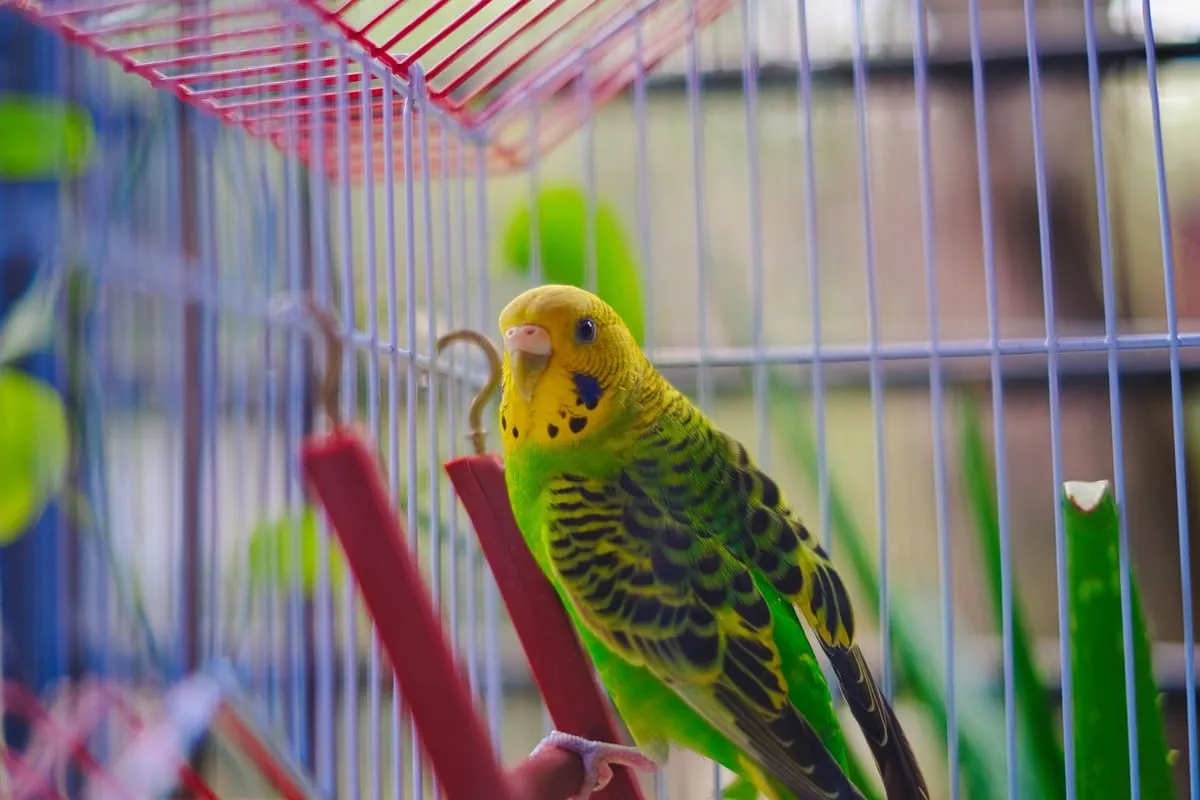
A budgie cage needs natural branch perches of different thicknesses, a food dish and a water dish placed clear of any perch above them, a cuttlebone or mineral block, and two or three toys that cover chewing, foraging and climbing. Everything else should be empty space to fly across. A cage crammed with accessories is a smaller cage.
That is the short answer, and the hardest part of it for most people is the last sentence. The instinct with a bare-looking cage is to fill it, and a budgie needs the opposite: a clear flight path from one end to the other, with the useful things arranged around the edges.
Start with the cage itself
Before anything goes inside, the cage has to be the right shape, and a great many cages sold for budgies are not.
Budgies fly horizontally in short bursts. They do not hover and they do not climb the way a parrot does, so height above a certain point is close to wasted while width is everything. Buy the widest cage you can fit in the room, and if you are choosing between a tall narrow cage and a wide shorter one at the same price, take the wide one every time. Bar spacing should be narrow enough that a budgie cannot push its head through, since a head through the bars is one of the more common cage injuries. Horizontal bars on at least part of the cage give a bird something to climb.
A wide flight cage on a stand is the shape to aim for. Whatever you buy, treat the label as marketing rather than guidance: cages sold specifically as budgie cages are very often sized for the shop’s shelf rather than the bird.
Perches: the single most important thing inside
If you change one thing in a budgie cage, change the perches, because the ones supplied with most cages are actively bad for the bird.
A cage typically comes with two or three identical smooth dowel perches of the same diameter. A bird standing on the same diameter all day, gripping in exactly the same position, develops pressure points on the soles of its feet, and that is the beginning of the foot problems that plague caged birds. Feet need variety. Replace the dowels with natural branch perches of differing widths, so the foot has to grip differently in different spots. A knobbly natural branch perch is the cheapest meaningful upgrade you can make to a budgie’s cage, and a bendable rope perch shaped into a curve adds another texture and another grip width.
Place perches so that no perch sits directly above a food or water dish, and leave the middle of the cage clear so the bird has somewhere to fly across rather than only somewhere to climb. A rope ladder turns otherwise unused vertical space into climbing and foot exercise.
Food, water and the calcium block
Dishes are simple, and where you put them matters more than what they are.
Keep food and water well clear of anything a bird perches on above, for the obvious reason, and keep them apart from each other so a budgie is not dropping seed husks into the water. Wash and refill the water daily rather than topping it up. A fortified budgie food is a reasonable base, and it is worth knowing that a diet of plain seed alone leaves gaps that show up later, which is the subject of our guide to why an all-seed diet is bad for your bird.
A cuttlebone or a mineral block clipped to the bars gives a budgie calcium it can take at its own pace, and it doubles as something to chew. A clip holder keeps it in place instead of on the cage floor. Grit, on the other hand, is a leftover piece of old advice: budgies shell their seed before swallowing and do not need it, and offering it loose can cause problems rather than solve them.
A shallow dish of water for bathing, offered a few times a week, is one of the easiest ways to make a budgie visibly happier. Many will splash enthusiastically once they work out what it is.
Toys: three jobs, a small set, rotated
A budgie in the wild spends its day flying, foraging and chewing vegetation. Toys exist to replace that work, which is why a toy that only dangles there does very little.
Cover three jobs. Something to shred, because chewing is a natural and satisfying budgie behaviour and it is far better aimed at a toy than at your furniture: a palm-leaf shredding toy or a small crinkle-paper star is exactly the right scale for a budgie beak. Something to forage from, which is the single most valuable category, because making a bird work for food is the closest thing to a cure for cage boredom: a cage-mounted foraging ball or a see-through foraging box does this, and so does simply wrapping a little food in paper. And something to move on or with, whether that is a ladder, a swing or a woven lattice ball stuffed with paper and millet.
Spray millet deserves a mention as the bridge between food and toy. Clipped high, or hidden inside a foraging toy, it is the treat almost every budgie will work for, and it is the easiest way to teach a nervous bird that coming close to you is worthwhile. Offer it as a reward rather than leaving it in permanently, since it is rich and a budgie will eat little else while it is there.
The things to leave out
A short list of common cage contents does more harm than good.
Sandpaper perch covers, as above. Grit offered as a dietary item. Mite and lice sprays used routinely rather than for an actual, identified problem. Fabric hanging toys with loose threads, or anything frayed, since a budgie’s toes and legs catch in loops with alarming ease and that is a genuine emergency. Anything painted, galvanised or made from an unknown metal, because some metals are toxic to birds. Scented or treated cage liners, when plain paper does the job and lets you see the droppings, which are one of the earliest signals that something is wrong.
Mirrors sit in their own category. A lone budgie will often bond with its reflection, court it and regurgitate for it, and because the reflection never responds properly the bird can become frustrated, territorial or hormonally stuck. A small mirror toy is fine as one item among many for a bird with company and plenty to do. It is not a substitute for a companion, and if it is the only thing your budgie interacts with, the honest answer is a second budgie or a great deal more of your time.
Light, dark and quiet
Two last things belong in the cage setup even though neither is an object you place inside it.
Budgies need a proper night. Ten to twelve hours of genuine darkness and quiet is what these birds are built for, and a cage in a room with a television on until midnight does not provide it. A breathable cage cover is the simple fix, and sleep deprivation is behind more crankiness and hormonal behaviour in pet birds than most owners suspect. And keep the cage out of direct draughts, out of the kitchen, since fumes from overheated non-stick cookware are rapidly fatal to birds, and somewhere the family actually is, because a budgie is a flock animal and a cage in an empty spare room is a lonely place.
Get the cage wide, the perches varied, the food and calcium right, a small rotating set of toys that make the bird chew and forage, real darkness at night and real time outside the bars, and you have covered almost everything a budgie needs. For the wider enrichment picture, why a bird will not play with its toys works through what to do when a bird ignores all of it.
Common questions
- What should be in a budgie cage?
- Natural branch perches of varying thickness, a food dish and a water dish placed away from under any perch, a cuttlebone or mineral block, two or three toys covering chewing, foraging and movement, and a bath dish offered regularly. Leave the rest of the floor and air space clear, because a budgie needs room to fly across the cage more than it needs another accessory.
- What size cage does a budgie need?
- Wider matters more than taller, because budgies fly horizontally rather than hovering. Buy the widest cage you can fit, with bar spacing narrow enough that a budgie cannot get its head through, and treat any cage sold as a budgie cage with suspicion, since a great many of them are far too small. A single budgie in a small cage with no out-of-cage time is the most common welfare problem in the species.
- Are mirrors bad for budgies?
- They are a mixed thing rather than an outright harm. A lone budgie may bond with its reflection, court it, regurgitate for it and become frustrated or territorial because the reflection never responds, and in hens it can encourage hormonal behaviour. If a mirror is the bird's main companion, the honest fix is a second budgie or much more of your time rather than removing the mirror alone.
- What should never go in a budgie cage?
- Sandpaper perch covers, which damage feet, grit offered as a dietary item, which budgies do not need and can cause blockages, mite sprays or treatments used without cause, loose threads or fabric a bird can catch a toe in, and anything painted or made from an unknown metal. Cage liners should be plain paper, not scented or treated.
- Do budgies need toys?
- Yes, and the useful ones are the ones that involve chewing, foraging or moving rather than just sitting there. Budgies in the wild spend most of the day flying, foraging and chewing vegetation, so a shreddable toy, a foraging toy that makes them work for food, and something to climb replace work the cage has taken away. Rotate a small set rather than filling the cage.