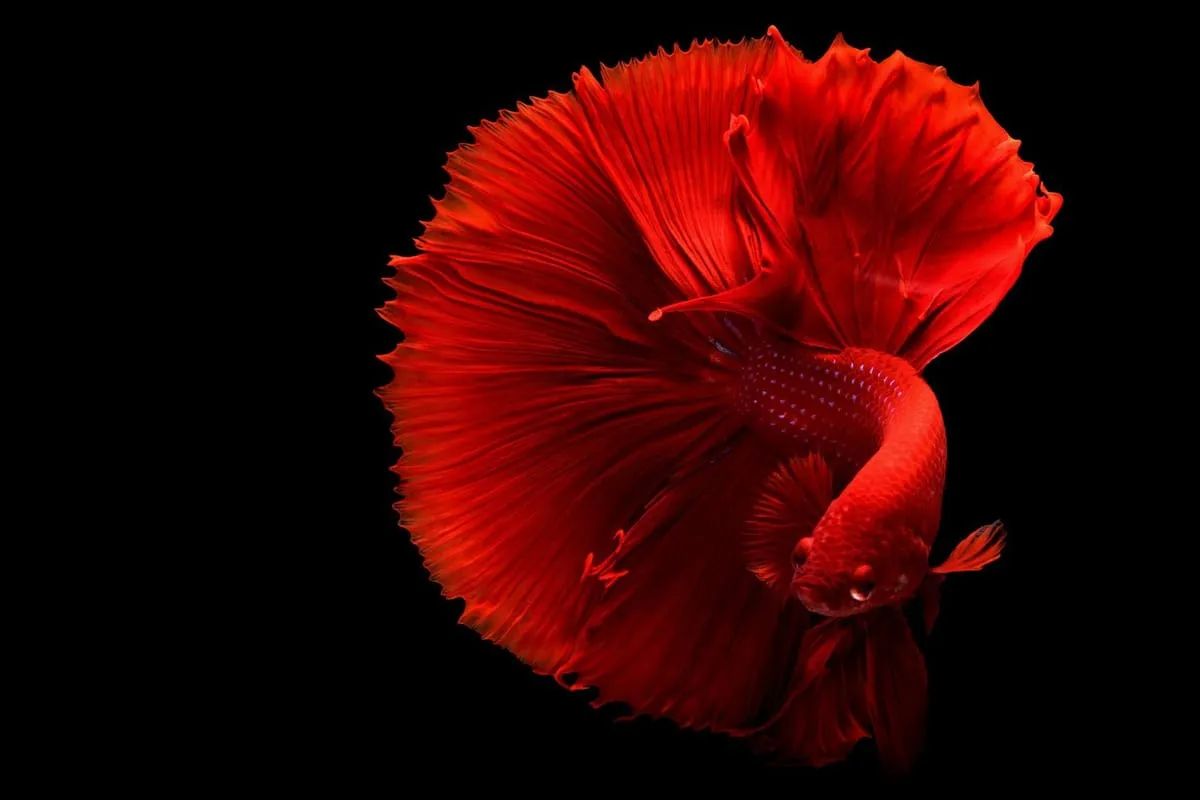
A betta in full flare is one of the more dramatic things a home aquarium does: gills spread wide into a collar, fins fanned out to their fullest, colours intensified, the whole fish suddenly looking twice its size. The first time an owner sees it, the instinct is often to panic, assuming the fish is in pain or distress. Almost always it is neither. Flaring is a betta doing exactly what its name, Siamese fighting fish, describes, a territorial and competitive display aimed at something it has identified as a rival, and it is one of the most normal behaviours in the species rather than a red flag by itself.
What flaring actually is
Before worrying about a flaring betta, it helps to know what the display is actually for, because that changes how you read it.
Flaring is a size-and-strength display, the aquatic equivalent of a cat arching its back or a dog raising its hackles. By spreading its gill covers and fins as wide as possible, a betta is signalling “I am bigger and more formidable than you think, back off” to whatever it has identified as a threat to its territory, almost always another male betta or something resembling one. It is a contest of display rather than an automatic prelude to violence, and in the wild and in well-set-up tanks, flaring alone often settles a dispute over territory without any actual fighting, which is the whole evolutionary point of the display existing. A betta that flares, gets no response, and then relaxes and swims off has done exactly what the behaviour is for.
What sets it off
Bettas cannot reliably tell a genuine rival from something that merely looks like one, which explains most of the flaring an owner sees that has no obvious cause.
The clearest trigger is another male betta, whether in the same tank, a neighbouring one, or even a photo or video of one, since the colours and fin shape are enough to read as a rival. Just as commonly, a betta flares at its own reflection in a glass tank wall, a glossy ornament, or a dark window at night, because a mirror image has exactly the colouring and fin display of a competing male and the betta has no way to recognise it as itself. This is worth knowing before assuming something in the water is wrong: a betta flaring at seemingly nothing has usually spotted a reflection the owner has not noticed. Our betta fish care guide covers why males cannot be housed together at all, which is the same territorial instinct behind flaring taken to its real-rival conclusion.
When flaring stops being normal
The display itself is not the concern. How often it happens, and whether the betta can ever resolve it, is what separates healthy flaring from a welfare problem.
A betta that flares occasionally and then settles is fine. A betta that flares constantly, for extended periods, at a trigger it cannot escape, is a different situation, because a stress response with no resolution is draining even when the thing setting it off is harmless. This is exactly why deliberately using a mirror as “exercise” or “enrichment” for a betta, an idea that circulates in some care advice, is a bad one: a mirror image never leaves, never backs down, and never stops looking like a rival, so repeated mirror flaring creates sustained stress with no winner and no off switch, rather than anything resembling healthy stimulation. The same logic applies to two tanks positioned so their bettas can see each other constantly, which can produce near-permanent flaring rather than the brief, resolving kind. Moving tanks apart, blocking the sightline, or using a background on one side solves this far better than letting the display run indefinitely.
Telling flaring apart from aggression toward tankmates
Flaring at a reflection or a distant rival is a display with no target that can actually be reached. Flaring followed by chasing, nipping, or cornering a real tankmate in the same tank is a different, more urgent problem.
If a betta is flaring at and then attacking fish it actually shares water with, that is genuine incompatibility rather than harmless display, and it needs a real fix, usually separating the fish, rather than being left to settle on its own. Our guide to why fish are fighting covers how to tell a display from a real aggression problem and what to do about tankmates that are not working out. The distinction matters: a betta flaring at its own reflection is putting on a show for no one, while a betta flaring at and chasing a tankmate is a fish that genuinely needs that tankmate moved.
A betta throwing a full flare is, in almost every case, a healthy fish doing exactly what its instincts tell it to do when it thinks it has spotted a rival. The behaviour itself is nothing to fix. What is worth managing is the trigger, making sure it is occasional rather than constant, and making sure it is never a reflection or a permanent sightline that an owner has unintentionally set up to flare at forever.
Common questions
- Is it bad for a betta to flare?
- Occasional flaring at a perceived rival is normal betta behaviour, not a sign of poor welfare on its own. It becomes a concern if it happens constantly, for long stretches, or in response to something the betta cannot get away from, since prolonged stress responses are draining even when the trigger is a harmless reflection rather than a real rival.
- Why does my betta flare at its own reflection?
- A betta cannot tell its own reflection from a rival male, so a shiny tank wall, a window at night, or anything reflective can trigger the same territorial display a real intruder would. It is a case of mistaken identity rather than the betta knowing it is alone and flaring anyway.
- Should I let my betta flare at a mirror for exercise?
- No. This used to be suggested as enrichment, but repeatedly flaring at a mirror image that never leaves and never backs down is a stress response with no resolution, closer to provoking a fight that cannot end than a workout. It is better to remove reflective triggers than to create them deliberately.
- Can two bettas be kept where they can see and flare at each other?
- Brief, occasional flaring through a divider or across tanks is generally tolerated, but it should not be constant. A betta that is flaring for long periods because it can permanently see a rival is under sustained stress, so dividers, tank placement, or background should block that sightline most of the time.